
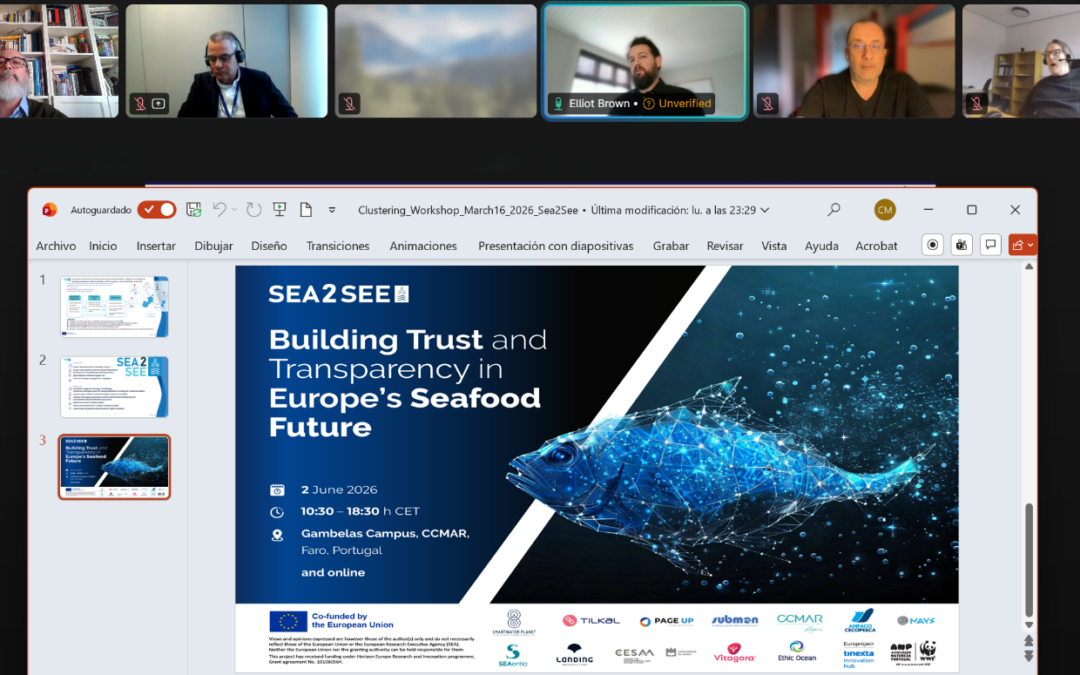
On 16 March 2026, SEA2SEE Coordinator Carlos Mazorra joined a diverse community of European research and innovation projects at the Clustering Workshop on Food from the Ocean and Freshwater Resources, held under the EU’s Food 2030 R&I framework. The online event brought together projects spanning aquaculture, fisheries, food innovation and digital technologies, creating a space for exchange, reflection, and most importantly, connection.
The workshop at its core reflected the growing recognition that transforming food systems is not the result of isolated innovation, but of coordinated action across disciplines, sectors and value chains.
A shared framework for transformation
Food 2030 provides the European Union’s strategic research and innovation framework for building sustainable, resilient and inclusive food systems. Through its systemic approach, it connects environmental, social, and economic dimensions, advancing four key priorities: sustainable nutrition, climate-smart food systems, circularity and innovation driven by empowered communities.
Within this context, the workshop focused specifically on food from oceans and freshwater resources – an area where sustainability challenges and opportunities are deeply interconnected. From circular aquaculture systems to ecosystem-based fisheries management and digital traceability, participating projects demonstrated the breadth of innovation currently shaping Europe’s blue food future.
From innovation silos to interconnected solutions
The workshop format encouraged concise project pitches followed by open discussion, allowing participants to explore both achievements and persistent challenges. Projects presented tangible impacts across the Food 2030 priorities, from reducing waste and valorising side streams, to developing alternative aquatic proteins and advancing ecosystem-based management approaches.
A key takeaway was the observed strong complementarity between projects:
- Circular aquaculture initiatives are redefining resource efficiency through innovations such as wastewater-based aquaponics and zero-waste feed systems.
- Blue bioeconomy projects are unlocking value from previously discarded biomass, contributing to both sustainability and economic resilience.
- Fisheries and ecosystem management projects are integrating ecological, economic and social data to support more adaptive and inclusive decision-making.
- Digital and data-driven initiatives are enhancing transparency, compliance and digital traceability across the seafood value chain.
Together, these efforts demonstrate a shift from fragmented innovation towards a more connected, systems-based approach.
SEA2SEE’s role: connecting data, trust and people
Within this ecosystem, SEA2SEE contributes a critical piece of the puzzle: trust.
Seafood remains one of the most globally traded, and information-asymmetric, food commodities. Complex supply chains, fragmented data and inconsistent communication have historically limited transparency and consumer confidence.
SEA2SEE addresses this challenge through its blockchain-based traceability platform, combining digital technologies with stakeholder engagement strategies to make sustainability visible, credible and actionable. By enabling transparent data collection, verification and communication, the project bridges the gap between producers, supply chain actors and consumers at the end of the value chain.
What we evidenced from the workshop is that SEA2SEE’s work resonates strongly with parallel sister project initiatives such as fisheries data spaces and monitoring platforms, highlighting clear opportunities for interoperability and cooperation. These connections are essential for scaling impact beyond individual projects and ensuring that solutions are not only innovative in nature but also usable and widely adopted.
Collaboration as a catalyst for impact
An added benefit of the workshop was the created space to reflect on broader research and innovation needs. Discussions highlighted recurring challenges, to include:
- Translating research outputs into market-ready solutions
- Ensuring interoperability between digital systems
- Bridging gaps between scientific knowledge and end-user needs
- Strengthening policy alignment and regulatory support
Addressing these challenges requires continued collaboration during project lifetimes and also across programmes, sectors and policy frameworks in order to build pathways for collective impact.
Looking into the future
As SEA2SEE approaches its final phase, engagement in initiatives like the Food 2030 clustering workshop reinforces its strategic direction: contributing technological solutions tied to enabled connections across the aquatic food system.
Because the future of sustainable seafood in Europe cannot be shaped by a single innovation but rather by the ability of many innovations to work together.